How to Identify Your Water Service Line Material in Pennsylvania
A service-line record marked “unknown” can leave homeowners unsure where to look or whom to ask. You can start by finding the pipe where it enters the building, but a quick visual check is not always enough to identify its material or the full line. This guide explains how to inspect what is accessible, compare your observations with utility records, and get uncertain sections checked.
Know which pipe you are trying to identify
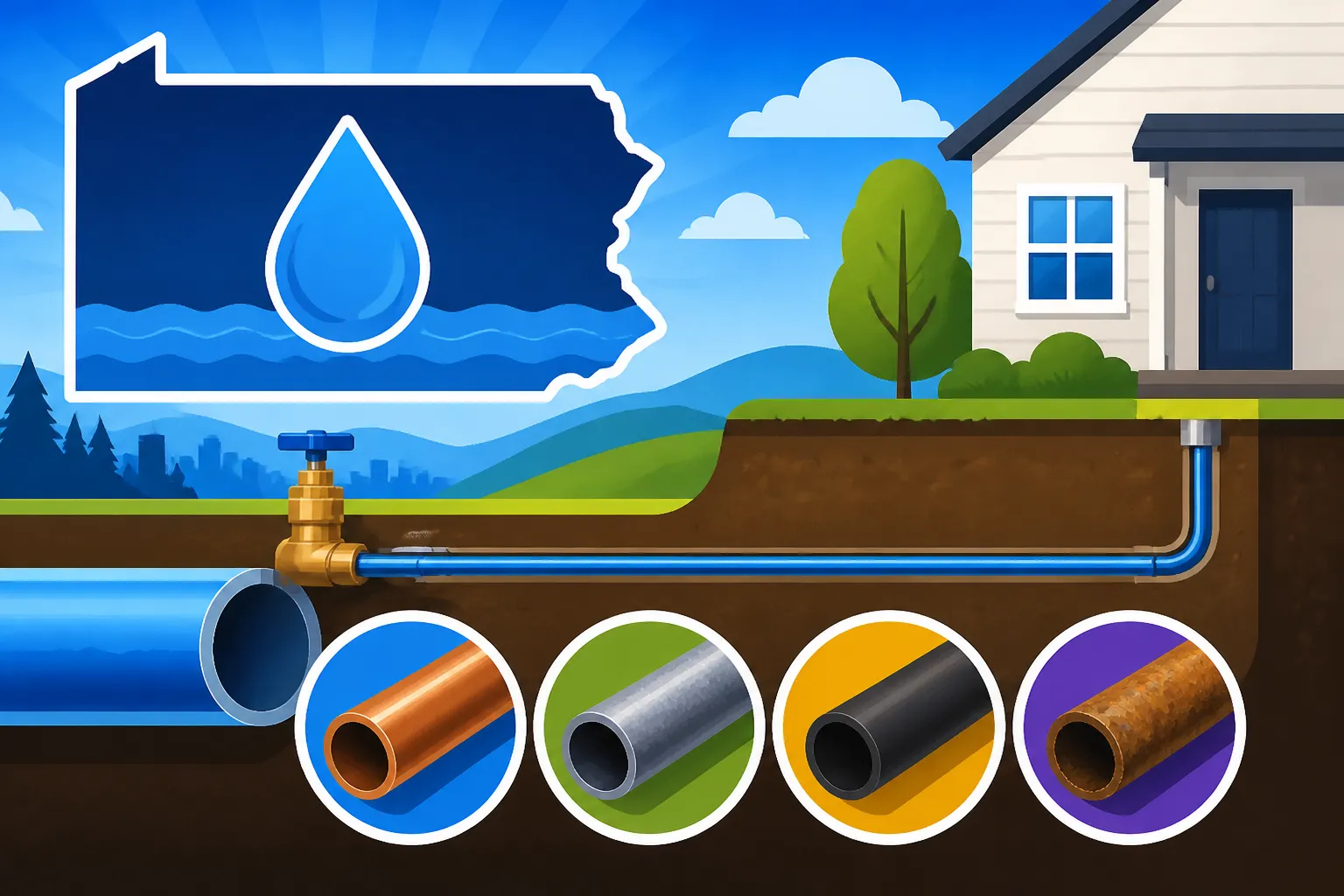
The service line is the pipe that connects a building to the water main. The City of Lancaster, Pennsylvania, describes it this way: Connects your home or building to the water main in the street. It is different from the pipes inside your home, which carry water from the service-line entry point to faucets and appliances.
The City of Lancaster, Pennsylvania, lists possible service-line materials as: Lead, copper, galvanized metal, or plastic. A line may also have different materials along its route, so identifying one visible section does not necessarily identify the entire line.
That distinction matters when checking a utility record. A material listed for the section on the utility side of the property line may not describe the section on the customer side, and a visible pipe inside the building may be a plumbing connection rather than the service line itself. Confirm which segment a record refers to before treating it as a description of the whole connection.
If you are unsure where the service line enters your home, look near the water meter or where the main shutoff valve and plumbing enter the building. The entry point can vary with the building and its plumbing layout. Don’t assume that every pipe near the meter belongs to the service line, or that a pipe visible indoors continues unchanged all the way to the street.
It may help to sketch the route as you understand it: the entry point, meter, shutoff, and the direction the line appears to take toward the street. Treat that as a working note, not a verified map. Some of the line may be underground or concealed by walls, floors, landscaping, or pavement.
A record can also use an unfamiliar term or describe the line as unknown. An unknown classification does not tell you the material; it means you need clarification or additional evidence. For help interpreting a notice, see Lead, Galvanized or Unknown on a Pennsylvania Service Line Letter. If you are trying to locate the relevant utility record or map, Is Your Address on a Pennsylvania Service Line Inventory Map? explains what to look for.
Check the available records before inspecting the pipe
Start with information you can get without disturbing plumbing or digging. Look for a service-line inventory, a customer letter, property records, or paperwork from a past plumbing or water-service project. A map or letter may identify only part of the line, and it may show a material classification without describing how that classification was established. Keep a copy of what you find and note the date and address it applies to.
The Pennsylvania Department of Environmental Protection directs water systems to review available historical records, including prior materials evaluations, construction and plumbing codes, water-system records, and distribution-system inspection records. It also directs them to document the techniques used to identify materials. That is useful context when you ask a utility how it classified your line: the answer may depend on records, inspection, or both.
A record search can raise as many questions as it answers. For example, a past plumbing permit may refer to work in the building without describing the buried section between the building and the main. A utility map may show the utility-side segment while leaving the customer-side segment unconfirmed. A contractor’s invoice may name a replaced pipe but not say whether other segments were left in place.
When you review a record, note:
- Whether it refers to the service line, interior plumbing, or both.
- Which segment or side of the property boundary it describes.
- Whether the entry is a confirmed material or an unknown classification.
- What evidence the utility says supports the classification.
- Whether the record appears to cover the current building and service connection.
If the documentation says only “non-lead,” ask what material was identified and what portion of the line that finding covers. If it says “unknown,” ask what information is missing and whether the utility has a process for reviewing records or checking the line. The practical next step depends on the answer, so avoid interpreting a category without its context.
You can also ask whether earlier repairs, a meter relocation, a change in the building’s use, or work by a previous owner appears in the utility’s records. The point is not to assume that a record is wrong, but to understand whether it describes the same line and the same section you are trying to identify.
For a wider discussion of how a service-line inventory should be read, see Pennsylvania Service Line Inventories: Deadlines and Customer Notices. For questions about responsibility for different sections, Which Part of the Service Line Does a Pennsylvania Homeowner Own? can help you frame the issue before arranging work.
Inspect only the accessible section, and treat visual clues as clues
If a section of pipe is visible where the service line enters the building, you can make a careful visual observation. Do not dig, cut, sand, scrape, or otherwise damage a pipe to identify it. If the line is concealed or you cannot tell where the service line transitions into interior plumbing, stop at what you can see and ask the water supplier or a qualified plumbing professional about verification.
The following table summarizes common clues. None of them, by itself, confirms the material of an entire service line.
| Possible material | Clues on an accessible pipe | Why the clue is not conclusive |
|---|---|---|
| Lead | Often appears dull gray; the visible surface may have a soft-looking or irregular appearance | Paint, oxidation, dirt, and nearby fittings can obscure the pipe; a visible lead-like section does not establish the material of buried segments |
| Copper | Often has a reddish-brown color, though the surface may be darkened or coated | A fitting or short copper section does not prove that the whole service line is copper |
| Galvanized metal | Often appears gray and may look like rigid steel pipe | Coatings, age, paint, and fittings can make it difficult to distinguish from other materials by sight |
| Plastic | Often has a smooth, nonmetallic appearance and may have markings | Markings can be hard to see, and a plastic section does not establish the material of the rest of the line |
| Unknown or mixed | Different-looking materials may appear along the route, or the pipe may be hidden | A transition can occur underground or behind a wall, so visible sections may represent only part of the line |
A magnet can help distinguish some exposed metal from nonmetallic pipe, but it is only a screening clue. A magnet sticking to a section does not identify the pipe as galvanized, and a magnet that does not stick does not prove that the section is lead. Copper and lead are not identified reliably by a magnet, and a service line can have more than one material.
Color is also a limited clue. Pipes may be painted, coated, oxidized, dirty, or partly hidden by insulation. A connection or elbow can be a different material from the straight run. Even a clear-looking pipe near the meter may be an interior plumbing segment rather than the buried service line.
Avoid scratch tests. They can damage a pipe or fitting and still leave you with an uncertain result. Do not remove insulation or wall coverings, disturb a meter assembly, or loosen a joint just to see what is underneath. If safe access requires moving, opening, or disconnecting anything, have the work assessed by a qualified professional.
Write down what you observed without turning a clue into a conclusion. For example: “Gray metal pipe visible after the meter; material not confirmed” is more useful than “whole service line is galvanized” if you have seen only a short section. Photographs can help when you contact the supplier, but avoid disturbing the pipe to get a better picture.
A utility’s physical check may involve more than looking at the pipe inside the building. The Pennsylvania Department of Environmental Protection’s instructions refer to visual inspection or mechanical excavation for physical checks. DEP does not specify one required inspection technique; it directs systems to review records, document the techniques used, explain how lines were selected for physical checks, and record material information by segment. Ask the utility what its own process can establish and what work, if any, would be needed to see a concealed section.
If a fitting or short connector is the only part you can see, it may be a separate component rather than a reliable indicator of the line material. In particular, an older connector can complicate an otherwise simple-looking inspection. What Is a Lead Gooseneck, and Does Your Home Have One? covers why that small section may need to be considered separately.
Ask the water supplier for a segment-specific answer
If your own inspection and paperwork do not settle the question, contact the water supplier serving the property. You can find the supplier by checking a water bill or using Who Supplies Water to Your Pennsylvania Address? How to Check. Use the official utility website to find current contact details, and have the service address and any inventory entry or customer notice available.
Be specific about what you want confirmed. “Is my line lead?” may not get a useful answer if the utility’s record refers only to one segment. Instead, ask what material is listed for each part of the connection, which portions have been physically checked, and which remain unknown.
Useful questions include:
- What material is recorded for the utility-side segment?
- What material is recorded for the customer-side segment?
- Does the record describe the full line or only a section?
- Was the material identified from historical records, a visual inspection, or another method?
- If a section was physically checked, where was it checked and what did that check establish?
- What does the utility mean by “unknown” in this record?
- Is there a way to submit photographs or documentation for review?
- What steps are available if records and an indoor visual check do not resolve the material?
Ask the supplier to explain any terms that are unclear. “Unknown,” “not inspected,” and “not confirmed” may be used in ways that reflect different evidence gaps. The key is to learn what the entry means for your address, rather than assuming that one label answers every question.
If you rent, you can still ask the supplier what information it can provide about the service-line record for the address. You may also need to ask the landlord or property manager for access to the water-entry area or copies of plumbing records. Responsibilities for arranging access or work can depend on the circumstances; do not assume that an inventory entry alone settles who must take action. How Pennsylvania Renters Can Get the Water Report a Landlord Receives explains a separate way renters can seek water-system information.
If the utility cannot confirm the material from existing records, ask what verification options it offers or recommends. A utility may have its own inspection practices, and the right next step can depend on what is visible, what records exist, and whether excavation would be necessary. The Pennsylvania Department of Environmental Protection’s instructions describe review of historical records and physical checks, but do not specify one required inspection technique. That means a careful question is more useful than assuming every address will be checked in the same way.
Keep notes of whom you contacted, what part of the line the answer covers, and any follow-up the supplier recommends. If you later hire a plumber or other qualified professional, those notes can help avoid repeating the same record search or mistaking one segment for the whole line.
Understand what confirmation does and does not tell you
Identifying the material of a service line is not the same as testing water from a tap. A material record describes the pipe or a section of it; it does not report a sample from your own faucet. Likewise, a water test may answer a question about the sampled water without identifying the material of buried pipe. The two forms of information serve different purposes.
If you want to understand what a water-quality result can say about your tap, see Does a Pennsylvania Water Quality Report Describe Your Own Tap?. For a home sample, How to Read a Pennsylvania Water Test Report, Line by Line can help you interpret what the report actually covers. Keep service-line records and water-test results together, but do not treat one as a substitute for the other.
A confirmed material for one segment may leave another segment unresolved. For example, an indoor inspection may identify the pipe at the entry point but not the portion underground. A utility record may describe the segment nearer the main but not the part inside the property. When the information differs, ask for the boundary and evidence behind each entry rather than choosing whichever description seems more reassuring.
It is also possible for records to be old or incomplete. That does not automatically make them wrong, but it is reasonable to ask whether later repairs or inspections were added. If you have invoices, photographs, permits, or records from a prior owner, share them with the supplier and ask whether they change the classification. Keep the original documents and provide copies if requested.
If the line is identified as lead or galvanized metal, or if a segment remains unknown, ask the supplier what it recommends for that classification and what additional information would be useful. Do not assume that a filter, a plumbing change, or a water test alone answers the service-line identification question. Decisions about treatment should be based on the specific water concern and appropriate test results; Choosing a Water Filter in Pennsylvania: Start With Your Test Results explains why matching treatment to evidence matters.
For a suspected lead concern, the utility may be able to explain its records and sampling options. A test at the tap can provide information about the sampled water, but it does not map the full service line. For more context, read Should Pennsylvanians Trust Utility Results, Test the Tap or Filter? and How Home Plumbing Changes What Comes Out of a Pennsylvania Tap.
The most useful outcome is a record that states what was identified, where the finding applies, and what remains uncertain. If you cannot get that level of detail in one conversation, ask for the answer in writing or request the inventory entry and its explanation. A clear distinction between confirmed and unknown segments is more valuable than a broad label that leaves the extent of the finding unclear.
Frequently Asked Questions
Can I identify the entire service line by looking at the pipe inside my home?
Usually, an indoor view can tell you only about the section that is visible. Buried or concealed portions may be made of a different material. Ask the water supplier which segments its records describe and what additional checks are available.
Does a magnet prove that a pipe is galvanized?
No. A magnet can be a clue for some metal pipe, but it does not identify the material on its own. Use it only as a preliminary observation, not as proof of the service-line material.
What should I do if the utility lists my line as unknown?
Ask which segment is unknown, what evidence the utility has, and what steps could clarify the record. Share relevant property or plumbing documents, and ask whether a physical check is an option.
Does a water test identify the pipe material?
No. A tap-water test describes the sample collected, not the material of the entire service line. Use the test and the service-line record as separate pieces of information.
Sources
- City of Lancaster, Pennsylvania (checked October 9, 2026)
- Pennsylvania Department of Environmental Protection — SERVICE LINE INVENTORY INSTRUCTIONS (3930-FM-BSDW0119, Rev. 9/2025) (checked November 13, 2026)
Disclaimer
This article is for general informational purposes only and does not constitute professional advice. Laws, prices and regulations vary by location and change over time. Consult a qualified professional for guidance on your specific situation. Pennsylvania Water Guide is not a government agency or water utility and is not affiliated with any public water system.