Who Pays to Replace a Lead Service Line in Pennsylvania?
A lead service line can run partly under public property and partly on private property, so the replacement bill may not have one simple answer. In Pennsylvania, responsibility depends on the pipe segment, the water supplier’s policy and any assistance available for the work. The practical first step is to confirm what material is present and get the cost allocation in writing.
The short answer: it depends on the pipe segment and the supplier
A service line is the pipe connecting a water main to a building. That connection can cross a property boundary, and the pipe on either side may have a different owner. Knowing who owns each part is important, but ownership alone may not tell you exactly what you will be asked to pay for a replacement project.
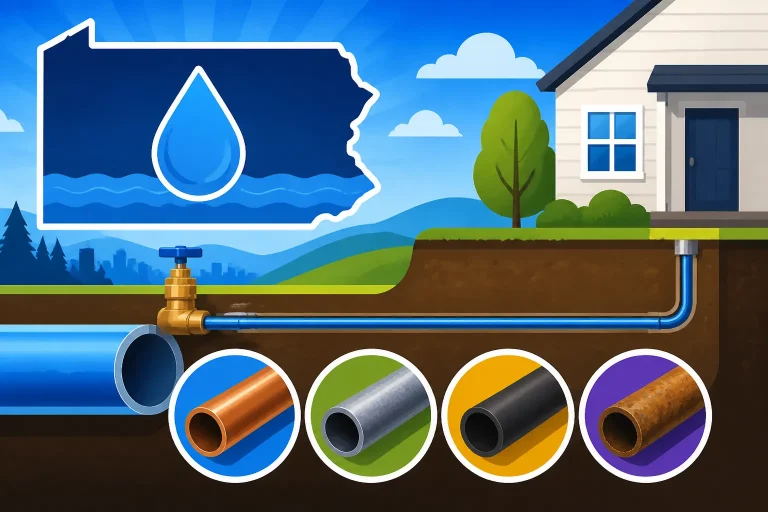
For Lehigh County Authority customers, the authority describes the division this way: According to Lehigh County Authority, Public side: LCA owns the pipe that runs from the water main to the curb. According to Lehigh County Authority, Private side: The property owner owns the pipe that runs from the curb into the home.
That description is specific to Lehigh County Authority. It should not be treated as a rule for every Pennsylvania water supplier. Each supplier may have its own service-line boundary, inspection process, replacement policy and financial assistance options. Even where a property owner owns the pipe on the private side, the supplier may have a program that affects how a project is coordinated or funded. Conversely, a supplier’s responsibility for the public side does not by itself establish that it will pay for private-side work.
The safest working assumption is that the bill could be divided by pipe segment, but you should not rely on an assumption when approving work. Ask the supplier to identify which section it considers public and which section it considers private, then request a written explanation of who pays for each part. Ask whether that explanation covers excavation, pipe replacement, restoration and any work needed inside the home.
| Question | What to confirm |
|---|---|
| Where does the supplier’s responsibility end? | The boundary it uses for the public and private sides |
| What pipe material is present? | The material of each section, not just the visible pipe in the basement |
| Who will do the work? | Whether the supplier arranges the project or the owner hires a contractor |
| What costs are included? | Excavation, replacement, restoration and any related plumbing work |
| Is assistance available? | Whether the supplier or another program offers funding, and who qualifies |
| What happens if the line is only partly replaced? | Whether any lead-containing section will remain and what temporary steps are recommended |
A line described as “unknown” does not confirm that it is lead, but it also does not establish that it is non-lead. Find out what the designation means, what evidence supports it and what inspection or documentation could resolve it. For practical identification steps, see How to Identify Your Water Service Line Material in Pennsylvania and Pennsylvania Service Line Inventories: Deadlines and Customer Notices.
Find out what material is in each part of the line
Before discussing a replacement bill, establish what pipe is present and where. A home may have different materials along the same connection: a public-side segment, a private-side segment and plumbing inside the building. A supplier’s inventory or letter may describe only the service line, not every pipe, fitting or fixture that could affect water at the tap.
Start with the records and information already available:
- Review any service-line notice from the supplier. Check whether it gives a material classification, says the material is unknown or explains how the classification was determined.
- Look for a service-line inventory or map maintained by the supplier. Treat a listing as a record to verify, not as a substitute for understanding what pipe is actually in place.
- Check closing documents, past plumbing invoices and renovation records. These may identify earlier work, although old records may not show the full route or current condition.
- Ask the supplier whether it has inspected the service line and whether the inspection covered the public side, private side or both.
- Ask what kind of evidence is needed to update a line’s classification. A visual check in the basement may not establish the material underground.
A service-line material check is different from a tap-water test. A material check is intended to identify what the pipe is made of. A tap test measures water from a specific sample under specific collection conditions. A line made from a material other than lead does not, by itself, establish what a tap test will show; likewise, a test result is not a complete record of every pipe segment on the property.
If you are unsure where the public portion ends and the private portion begins, ask the supplier to explain its boundary using your property and service-line layout. The boundary may be described by reference to a curb, a meter, a property line or another point. Don’t assume that the point is the same for every supplier or every property. The distinctions are covered further in Which Part of the Service Line Does a Pennsylvania Homeowner Own?.
If your notice says “unknown,” ask how the supplier reached that status and what can change it. A map can be useful for checking the supplier’s records, but a map entry is not necessarily an inspection result or a confirmation of the pipe material. See Is Your Address on a Pennsylvania Service Line Inventory Map? for more on interpreting an inventory listing.
When the material remains uncertain, ask the supplier whether it can inspect the line or explain what kind of qualified professional can do so. Before arranging digging or plumbing work, check whether the supplier requires approval, a particular inspection method or advance coordination. An inspection that is not accepted by the supplier may not update its records or resolve the question for its replacement program.
What can determine the replacement bill
The total cost is not simply the price of a new pipe. A project may involve locating the line, excavation, disconnecting and reconnecting the service, work near or inside the building, and restoring surfaces affected by construction. Which of these costs fall to the owner, the supplier or another party depends on the project and the supplier’s rules. Get the specific scope and cost allocation before work begins.
The public-side and private-side boundary
The most important starting point is the supplier’s responsibility boundary. If the lead-containing pipe crosses from a public area onto private property, the supplier may treat the segments differently. A supplier may coordinate replacement of its side while the property owner is responsible for arranging work on the private side, or a program may provide a different arrangement. Do not assume either outcome without confirming the current policy for your address.
Ask the supplier to mark or describe the relevant boundary and to explain whether its estimate covers only the section it owns. If a contractor’s proposal covers the whole route, compare it with the supplier’s stated scope. The two documents should make clear whether the work overlaps, leaves a section untouched or requires separate authorization.
Restoration and access work
Replacement may disturb a lawn, walkway, driveway, planting bed or other surface. The proposal should explain what restoration is included and what is excluded. If the work requires access through a basement, crawl space or finished area, ask whether repairs to interior surfaces or plumbing are included. A low estimate can omit work that will still need to be completed.
The route and site conditions matter as well. Ask who is responsible for locating buried utilities, arranging access and addressing unexpected conditions discovered during excavation. If the supplier is coordinating only part of the job, clarify who manages the handoff to the private-side contractor.
For questions about site disruption, Will Lead Line Replacement Tear Up Your Yard or Sidewalk? can help you prepare questions about excavation and restoration.
How the project is arranged
A supplier may perform work itself, use a contractor or require the owner to hire a contractor for a portion of the line. These arrangements affect more than scheduling: they can determine who obtains approvals, how the work is inspected and how costs are submitted for possible reimbursement or assistance.
Before signing a contract or paying a deposit, ask whether the supplier has requirements for contractors, materials, permits, inspections or coordination with the water service. Confirm whether the supplier needs to approve the scope in advance. If you hire a contractor independently, ask whether that affects eligibility for any assistance. Do not count on reimbursement unless the program confirms it in writing.
Partial replacement
A project may replace one segment while leaving another segment in place. Ask exactly what will remain after the work and why. If a lead-containing section remains, the project has not removed that section. Ask the supplier what it recommends for water use and any follow-up, and whether additional replacement work can be scheduled.
Avoid treating a partial replacement as equivalent to replacing the full lead-containing service line. The details matter: which section was replaced, what material remains, and whether any connected plumbing was also addressed. Keep the work order, inspection record and updated material classification with your property records.
Assistance and funding
Some suppliers or public programs may offer financial help, but availability and terms vary. Eligibility might depend on location, ownership, income, project timing or whether the supplier has approved the work. The existence of a general funding program does not guarantee that a particular property qualifies, and funding may not cover every project cost.
Ask the supplier whether assistance is available for your address and request the program’s written terms. Confirm whether an owner must apply before hiring a contractor, whether the program pays the contractor directly or reimburses the owner, and which costs are eligible. For broader background on possible support, see Loans, Grants and City Programs for Pennsylvania Lead Line Replacement. Check with the official program or supplier for current eligibility and application details.
How to get a clear answer before agreeing to work
A useful answer is specific to your address, the pipe material and the proposed project. A general statement such as “the homeowner pays” or “the utility handles it” may leave out a boundary, a funding program or part of the work. Put your questions in writing and keep the response with any estimate or notice.
Use this process:
- Identify the supplier. Confirm which water supplier serves the property, especially if the home is near a municipal boundary or receives water through another supplier.
- Request the line information. Ask for the supplier’s classification for each service-line segment and any inspection notes or inventory record it can provide.
- Ask for the ownership boundary. Have the supplier identify where its responsibility ends and the owner’s begins for this address.
- Request a written scope. Ask which segments will be replaced and which work is excluded.
- Request an itemized cost explanation. Ask who pays for excavation, pipe, connection, interior work, restoration and inspection.
- Check assistance before committing. Ask whether funding or a replacement program applies, what approval is needed and whether work must wait until eligibility is confirmed.
- Clarify the schedule and next steps. Ask who will contact you, who will arrange access and what happens if the supplier’s work and private-side work are scheduled separately.
- Keep the records. Save the notice, inspection information, written cost allocation, contract, receipts and final work documentation.
If you receive a letter that identifies a lead or unknown service line, read it closely and ask for the next step rather than assuming it is a bill or a final determination. A notice may be about material identification, planned inspection, replacement options or customer action. If something is unclear, ask the supplier to explain the status and whether any deadline or approval requirement applies. Lead, Galvanized or Unknown on a Pennsylvania Service Line Letter explains how to distinguish those classifications.
When the supplier gives a verbal answer, follow up by email or letter with a short summary and ask it to confirm. That creates a record of what the supplier says about ownership, cost and eligibility. If a contractor’s estimate conflicts with the supplier’s answer, pause before authorizing the work and ask both parties to clarify the difference.
Renters, buyers and owners who share responsibility
The person paying for the work may not be the person who received the notice or uses the tap. That is especially important in rental housing, condominiums and properties with shared service arrangements. Do not assume that a tenant can authorize replacement of a pipe owned by a landlord, or that a landlord has already contacted the supplier. Confirm who is responsible for making decisions and communicating with the supplier.
If you rent
Give the notice to the property owner or manager and ask who will contact the supplier. If the supplier’s letter was addressed to the landlord, request a copy or ask the landlord to share the relevant information. A tenant can still ask the supplier what the notice means, but the owner may need to authorize inspection or work on private property.
If the landlord and supplier give different explanations, ask them to clarify the service-line boundary and responsibilities together. Keep a copy of notices and written responses. For questions about who receives service-line notices in rental housing, see Renting in Pennsylvania: Who Legally Gets the Lead Pipe Letter?.
If you own a home or are buying one
For an existing home, ask whether the line has been classified, inspected or replaced, and request records rather than relying on a general assurance. A seller’s disclosure, a utility map or an old invoice may be useful, but each may cover a different part of the story. Ask who performed any inspection and what the record actually confirms.
For a purchase, make service-line material and replacement responsibility part of the property-information questions. Ask the seller for supplier notices, inspection records and invoices. Then confirm the current classification and policy directly with the supplier. A previous owner’s understanding of who pays may not match the supplier’s current record or the buyer’s project scope. Records to Request When Buying a Pennsylvania Home on Public Water offers related questions to raise during a purchase.
For condominiums, shared services or properties with more than one dwelling, establish whether the line serves only one unit or multiple units and who has authority to approve work. The association, landlord, owner and supplier may each have a role, but the precise arrangement depends on the property documents and supplier policy. Ask for the governing documents and supplier’s written position before making plans.
If the cost is difficult to manage
Tell the supplier that affordability is a concern and ask about assistance, payment arrangements or project coordination. Do not assume assistance exists, but do not assume that the full cost must be paid immediately without checking. Ask whether the supplier can explain available options, whether the work can be scheduled through a program and whether private-side costs are treated differently from public-side costs.
If an owner receives multiple proposals, compare the scope as well as the total. One quote may cover excavation and restoration while another may cover only plumbing. Ask each contractor to identify exclusions, explain how the work will connect to the supplier’s side and provide documentation of the material replaced. A comparison is useful only when the proposed work is comparable.
Frequently Asked Questions
Does Pennsylvania have one statewide rule for who pays?
The information here does not establish one cost rule for every Pennsylvania supplier. The ownership boundary and replacement policy can vary, so ask the supplier serving the property for its written rules and cost allocation.
If I own the private-side pipe, does that mean I must pay the full bill?
Not necessarily. Ownership is important, but it does not by itself confirm the cost of a particular project or rule out assistance. Ask who pays for each segment and related work, and get the answer in writing.
Does a lead or unknown service-line notice mean I have to replace the line immediately?
A notice alone may not answer what work is required or who pays. Read the notice, ask what the classification means and confirm any action, timing or approval requirements with the supplier.
Should I hire a contractor before contacting the supplier?
Contact the supplier first. It may have inspection, coordination or approval requirements, and starting work before confirming them could complicate the project or affect assistance eligibility. Verify the process for your address before authorizing work.
Sources
- Lehigh County Authority — Lead Service Line Replacement Program | Lehigh County Authority (checked November 13, 2026)
Disclaimer
This article is for general informational purposes only and does not constitute professional advice. Laws, prices and regulations vary by location and change over time. Consult a qualified professional for guidance on your specific situation. Pennsylvania Water Guide is not a government agency or water utility and is not affiliated with any public water system.