How Public Notification Works for Pennsylvania Drinking Water
A drinking water notice can be alarming, but the tier, deadline and delivery method help explain what it means and what to do next. Pennsylvania’s system sets different timelines for different situations. This guide explains how those tiers work, how notices may reach you, and how to check what a notice means for your household.
What Pennsylvania’s public notification system does
Public notification is how a water supplier communicates certain violations or other situations requiring customer attention. A notice is not just a technical report: it is meant to tell people what happened, how the supplier is responding and whether customers should take steps while the issue is addressed.
The Pennsylvania Department of Environmental Protection’s public notification rule became effective on May 6, 2002. Its framework assigns situations to tiers, with different deadlines and delivery requirements for each. The tier is a useful starting point, but it does not tell you everything about the event. Read the notice itself for the specific issue, the affected area and any instructions.
Not every change in taste, smell or appearance is automatically a violation or a public notice. A change can still be worth reporting to the supplier, especially if it affects several homes or continues. For possible causes and first checks, see Taste, Smell and Color Problems in Pennsylvania Tap Water.
A notice also differs from a yearly water quality report. A consumer confidence report summarizes water-quality information for a reporting period; a public notice communicates a particular situation that calls for notification. To understand the difference, see Pennsylvania Consumer Confidence Reports: A Reader’s Guide and How Pennsylvania Tap Water Quality Is Tested and Reported.
A notice may be the first time you hear about an issue, but it is not a substitute for checking the details. Confirm whether it applies to your service address, what action—if any—it asks you to take, and when the supplier expects to provide more information. If you are not sure who supplies your address, Who Supplies Water to Your Pennsylvania Address? How to Check explains how to identify the supplier.
How the three notice tiers differ
The tier reflects the kind of situation and the urgency of notifying customers. The Pennsylvania Department of Environmental Protection describes the tiers by health effects and exposure context. Treat the category as a signal to read the instructions promptly, not as a substitute for them.
| Tier | How DEP describes the situation | Public notice deadline |
|---|---|---|
| Tier 1 | Adverse health effects as a result of short-term exposure | Within 24 hours |
| Tier 2 | Potential to cause chronic health effects as a result of long-term exposure | Within 30 days |
| Tier 3 | Causes no health effects | Within one year |
According to the Pennsylvania Department of Environmental Protection, Tier 1 violations involve adverse health effects from short-term exposure. DEP requires Tier 1 public notices within 24 hours. If a notice identifies a Tier 1 situation, read its instructions as soon as you receive it and follow them. If the directions are unclear, contact the water supplier using current details from its official website.
According to the Pennsylvania Department of Environmental Protection, Tier 2 violations may cause chronic health effects from long-term exposure. DEP requires Tier 2 public notices within 30 days. That longer deadline does not mean customers should disregard a notice until the deadline passes. The notice should identify the situation and any response customers are asked to take; follow those directions rather than trying to infer urgency from the deadline alone.
According to the Pennsylvania Department of Environmental Protection, Tier 3 situations cause no health effects. DEP requires Tier 3 public notices within one year. A Tier 3 notice can still matter: it informs customers about a compliance or monitoring issue, even when the tier is defined as causing no health effects. Read it to understand what happened, whether it has been corrected and whether the supplier expects to provide an update.
The deadline is the time allowed for issuing the notice, not a prediction of how long the underlying condition will last. A supplier may take corrective action before a notice is delivered, or the issue may still be under review when the notice arrives. Look for the date of the event, the date of the notice and any explanation of what has changed since the issue was identified.
A tier also does not tell you whether every property in a town or service area is affected in the same way. The supplier’s notice should identify the system or customers involved. If it is not clear whether your address is included, check with the supplier rather than assuming the notice applies—or does not apply—to you. Tier 1, Tier 2 or Tier 3? How Urgent a Pennsylvania Water Notice Is offers a closer look at that distinction.
When notices must be issued
The Pennsylvania Department of Environmental Protection sets different notice deadlines by tier: within 24 hours for Tier 1, within 30 days for Tier 2 and within one year for Tier 3. The deadlines give suppliers different amounts of time to issue public notice depending on the situation’s tier. They do not, by themselves, tell a customer what to do with the water.
A notice deadline and a corrective-action deadline are not the same thing. Do not infer from the time allowed for notification that the supplier has that same amount of time to fix the issue, or that the issue remains unresolved until the notice arrives. The notice may describe corrective steps, but the available facts and instructions for a particular event are specific to that event. If a notice provides an update schedule, use it to track what the supplier says will happen next.
It is also useful to separate the date a situation occurred from the date you learned about it. A mailed notice may arrive after it was sent, and an email or posted notice can be missed. For Tier 1 situations, the Pennsylvania Department of Environmental Protection requires public notice within 24 hours, so customers should pay attention to alerts and delivery channels rather than relying only on a later letter. For background on why delivery may not reach everyone at the same time, see How Pennsylvania Water Notices Reach You, and Why Some Arrive Late.
If you encounter a notice after the date printed on it, check whether the supplier has posted a newer update or correction. Do not assume an older notice is still the latest information, and do not assume it no longer matters. The supplier’s official website is the practical place to look for current updates and contact details. If the notice gives instructions that appear to conflict with a newer update, ask the supplier which directions apply to your address.
There may also be notices about missed monitoring or reporting, rather than a confirmed contaminant-level problem. Such an issue can be important because required information may be incomplete, but it is not automatically the same as a result showing a contaminant above a limit. Read the wording carefully and distinguish what is known, what was not measured or reported, and what follow-up is planned. For a closer explanation, see A Notice About Missed Monitoring: Should Pennsylvania Customers Worry?.
How notices reach Pennsylvania customers
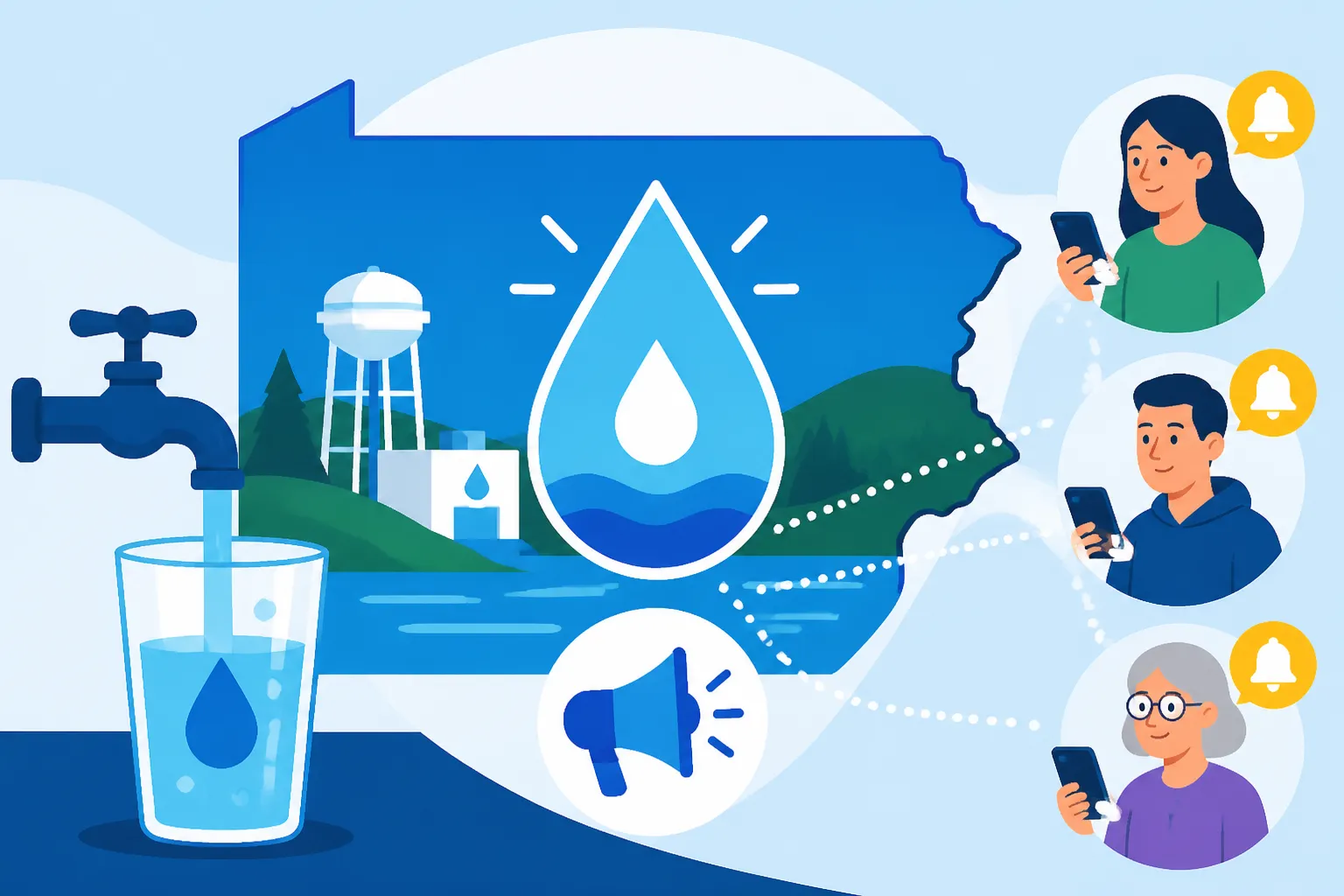
The required delivery method depends on the tier. According to the Pennsylvania Department of Environmental Protection, Tier 1 notices must use direct delivery of public notice to each service connection. Applicable transient and nontransient connections must also be notified through broadcast media. This is meant to make urgent notification direct while using broadcast media where the rule applies.
For Tier 2 and Tier 3, the Pennsylvania Department of Environmental Protection allows mail or other direct delivery, including electronic mail, and any other method as needed to reach others. The method used can therefore differ by supplier or situation. A household might receive a mailed letter, an email, or another direct communication. Do not rely on a single channel if you want to make sure you see notices promptly.
A renter may not receive a water notice directly if the account or service connection is associated with a landlord, property manager or building arrangement. If you live in a rental, ask the landlord or property manager how water notices are passed on and whether you can sign up for supplier alerts yourself. If you receive a notice for a building but are unsure which apartments are covered, ask the supplier or building manager to clarify. How Pennsylvania Renters Can Get the Water Report a Landlord Receives covers a related information gap for renters.
Apartment buildings and other properties with a shared or master meter can make it less obvious who the supplier considers the service connection. In that situation, a tenant may need to check both with building management and with the supplier to confirm how a notice is distributed. Master-Metered Apartment in Pennsylvania? Finding Your Water Supplier explains how to start that check.
A failed email delivery or a missed letter does not tell you whether a notice was issued or whether your address is affected. If neighbors mention an alert you did not see, check the supplier’s official website and ask whether the notice covers your service address. You can also ask how to enroll in available phone, text or email notifications. Keep your contact information current wherever the supplier manages customer alerts.
Broadcast announcements may be less specific than a direct notice. If you hear a message but cannot tell whether it concerns your supplier or service area, verify it with the supplier before acting on assumptions. Likewise, a notice circulated by a neighbor may be incomplete or out of date. Seek the current version from the organization responsible for your water service.
What to look for when you read a notice
Start with the supplier’s name and the area or customers covered. Confirm that the notice is for your water system and service address. A notice from a nearby town, a different utility or another part of a shared system may not apply to your home. If the covered area is described in unfamiliar terms, contact the supplier and ask directly whether your address is included.
Then look for the tier and the stated reason for the notice. The category gives context, but the explanation should identify the particular violation, monitoring issue or other event. Notice language can be technical; focus first on the explanation of what happened, when it was identified and what customers are asked to do.
Pay particular attention to any customer instructions. If the notice directs you to use an alternative source, avoid a particular use, or take another step, follow the directions as written. Do not replace a supplier’s specific guidance with general advice from an unrelated situation. If the notice gives no household action, that is different from an instruction to take action, but you can still contact the supplier if you need clarification.
Look for the supplier’s account of what it is doing in response. A notice may explain that the issue has been corrected, that investigation is continuing or that follow-up information will be shared. If the notice does not say when an update is expected, you can ask how to check for the next update. A correction or resolution does not necessarily mean that every question about your home’s plumbing or water has been answered; it addresses the particular situation described.
Check whether the notice explains the health context and exposure period. For example, the DEP tier descriptions distinguish short-term exposure situations from situations with potential chronic effects from long-term exposure. If the notice uses terms you do not understand, ask the supplier to explain them. For questions about personal health effects, consult a local health department or a medical professional rather than trying to make an individual medical judgment from a notice.
Finally, note the notice date and any date or time by which the supplier expects customers to act or receive more information. Keep a copy, including any envelope or email header if relevant. A record helps if you need to ask follow-up questions, compare the notice with a later update or explain the situation to a landlord or household member.
A useful way to read a notice is to separate its parts: what happened, who is affected, what the tier means, what customers should do, what the supplier is doing and where to get updates. If one of those parts is missing or unclear, ask a focused question about that item. For help with the language of water reports and technical terms, see How to Read Units, Limits and Violations on a Pennsylvania CCR.
What to do after you receive a notice
Read the entire notice before deciding what it means for your household. Identify the supplier, the affected service area, the tier and any action requested. If the notice includes instructions, follow them while you verify that they apply to your address. Avoid relying on a headline, a social media summary or a neighbor’s recollection when the official notice contains more specific directions.
Check the supplier’s official website for a current version or update. If the notice points to a particular update channel, use that channel. If you cannot determine whether your address is covered, contact the supplier through its official website and ask. Do not send personal account information to an unverified address or respond to a message that you cannot confirm came from the supplier.
If you rent, share the notice with the landlord or property manager and ask how the building is handling it. If other people in the home may not see email or online alerts, pass along the instructions and agree on where to check for updates. Keep the notice available so household members are working from the same information.
Do not assume that boiling, filtering or letting water stand is an appropriate response to every notice. The right action depends on the issue described and the directions provided. A household filter is not a universal substitute for supplier instructions, and a boil advisory has its own guidance. See A Homeowner’s Guide to Boil Water Advisories in Pennsylvania for that separate situation. If a notice raises questions about whether a home filter is suitable, check the device’s certification against the specific water concern and your test results; Choosing a Water Filter in Pennsylvania: Start With Your Test Results explains why matching matters.
For questions about a possible health effect, ask your local health department or a medical professional. The supplier can clarify the event, the affected service area and its response, but personal health questions are best directed to a qualified health resource. If someone has symptoms or a specific medical concern, do not use a water notice as a substitute for medical advice.
If a supplier says the issue has been resolved, keep the update with the original notice. If you still have questions, ask what was corrected, whether the notice applies to your address and whether additional customer action is needed. The goal is not to interpret a technical result in isolation, but to understand the current instructions for the water supplied to your home.
If you did not receive a notice or the message is unclear
A missing notice does not establish that a water issue exists, and it does not establish that one does not exist. Delivery can depend on the tier, the supplier’s method and the contact information associated with the service connection. If you learn about a possible notice from someone else, verify it with the supplier rather than relying on an informal summary.
Check your mail, email folders and any alert account you have set up. Confirm that the supplier has a current email address or other contact information for the account. Ask whether your property is covered by a landlord, master meter or another account holder, and whether you can receive notices directly. If the supplier uses an online notice page, check that page for updates and corrections.
If you received a notice but cannot identify its tier, affected area or requested action, ask the supplier for clarification using current contact details from its official website. It may help to have the notice in front of you and to ask specific questions: Does this apply to my address? What does the tier indicate in this case? Is there a customer action I should take now? Where will the next update appear?
If the notice seems inconsistent with a later message, ask which version is current. Keep both communications until the supplier confirms the current instructions. A corrected notice may replace earlier wording, while a follow-up may add information without withdrawing the earlier directions. Do not guess which one controls.
For a suspected delivery failure, note how you learned about the notice and what channel you checked. You can ask whether the supplier has a way to update contact information or enroll in alerts. Pennsylvania’s delivery requirements differ between tiers, so the absence of a particular format—such as a mailed letter—does not, by itself, show whether the supplier met its notification requirement. Emailed Water Notice Bounced? Pennsylvania’s Backup Delivery Rule discusses another reason a customer might miss an email alert.
If you are concerned that a notice was not issued or that the information does not answer your question, first ask the supplier for the notice and an explanation of its status. Keep a record of what you were told. If you need to understand a supplier’s broader test history or compliance records, separate those records from the immediate instructions in the public notice. Looking Up a Pennsylvania Water Supplier’s Violations and Test Records can help with that broader review.
A notice is most useful when you connect it to your own address and follow the supplier’s current instructions. Read it promptly, check for updates, and ask for clarification rather than filling gaps with assumptions. The tier and deadline provide important context, but the notice’s specific explanation and customer directions are what guide your next step.
Frequently Asked Questions
Does a Tier 3 notice mean there is no reason to read it?
No. According to the Pennsylvania Department of Environmental Protection, Tier 3 situations cause no health effects, but the notice still explains the situation and any relevant follow-up. Read it to understand what happened and whether the supplier has provided an update.
Does the notice deadline tell me how long an issue will last?
No. The deadline describes when the public notice must be issued, according to the Pennsylvania Department of Environmental Protection. It does not, by itself, say how long the underlying issue will continue or when corrective work must be complete.
Why might a renter not see a notice directly?
A notice may be sent through the service connection or account associated with a property. If a landlord, property manager or master meter is involved, ask how notices are passed on and whether you can receive supplier alerts directly.
What should I do if the notice does not say whether my address is affected?
Check the supplier’s official website and contact the supplier using current details listed there. Give the service address and ask whether it is included in the notice area.
Should I use a filter or boil water after every notice?
No. Do not assume either action is appropriate for every situation. Follow the instructions in the notice and ask the supplier if the directions are unclear. For questions about health effects, contact a local health department or medical professional.
Sources
- Pennsylvania Department of Environmental Protection — Public Notification | Department of Environmental Protection | Commonwealth of Pennsylvania (checked November 13, 2026)
Disclaimer
This article is for general informational purposes only and does not constitute professional advice. Laws, prices and regulations vary by location and change over time. Consult a qualified professional for guidance on your specific situation. Pennsylvania Water Guide is not a government agency or water utility and is not affiliated with any public water system.